Public Use Cases in HR, Business & Finance
Our Use Cases present the results of XTRACTIS modeling and include complete Benchmarks against Neural Networks, Boosted Trees, Random Forests, and Logistic Regression.
These studies illustrate the ability of XTRACTIS to automatically induce knowledge in the form of predictive and intelligible mathematical relationships from real-world data (public data or authorized private data).
For each application, we show how the induced decision system uses its fuzzy rules to compute explained predictions for new situations, i.e. unknown to the learning data set.
The benchmarks of XTRACTIS, Logistic Regression, Random Forest, Boosted Tree, and Neural Network are carried out on Test and External Test datasets (all the unknown cases of the reference dataset, i.e., not used for training or validation).
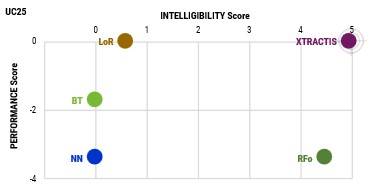
In this graph, the Intelligibility Score IS and the Performance Score PS are calculated from the public Use Cases (UC) in the HR, Business and Finance sectors and that include benchmarks of models.
The center of a bubble corresponds to the point of coordinates IS -on top- and PS -on bottom. A bubble on the top-right corner is the Holy Grail for critical AI-based decision systems: an AI Technique which produces predictive models with the highest Performance and the highest Intelligibility.

All quantitative metrics are defined in the use cases documents.

XTRACTIS discovers how we can automatically idenify and predict the wine’s origin from its physicochemical features in order to help preserve the wine’s protected designation of origin.

XTRACTIS discovers a company’s strategies to evaluate employees, highlighting the existing gender and age biases in these strategies.

XTRACTIS discovers a company’s strategies to evaluate employees, highlighting the existing ethnic bias in these strategies.